THE DECISION STABILITY FRAMEWORK
A framework for what happens after a consequential decision is made.
Making the choice is only part of the work.
Once a course becomes operative, implementation problems, pressure, changing conditions and new information can all call the decision into question. They do not all mean the same thing.
The Decision Stability Framework follows a consequential decision from recognition through action and into the post-Act period where what arrives must be distinguished.
Within Stabilise, Hold-or-Fold distinguishes pressure to hold through, implementation problems to repair and information that has earned review.
WHY DECISIONS COME APART
A sound decision can still come apart after it is made.
Once a consequential decision is underway, different challenges can begin to feel like the same problem. Pressure can make a sound decision feel wrong, while difficulties in carrying it out can make the choice itself look flawed. Circumstances may change, and new information may alter the reasons for continuing or leave them intact. The challenge is understanding what needs attention, rather than assuming the decision itself is the problem.
The Decision Stability Framework distinguishes between the decision, how it is carried out, the conditions surrounding it and information that may warrant review. That distinction matters: pressure may need attention, execution may need repair, or evidence may justify reconsidering the choice itself. Not every challenge should change the decision, but some should. The discipline is knowing the difference.
Four assets.
One integrated framework.
The Decision Stability Framework brings together four distinct elements. Together, they show where accountability rests, what surrounds the decision, how it moves and how the conditions around it can be worked.
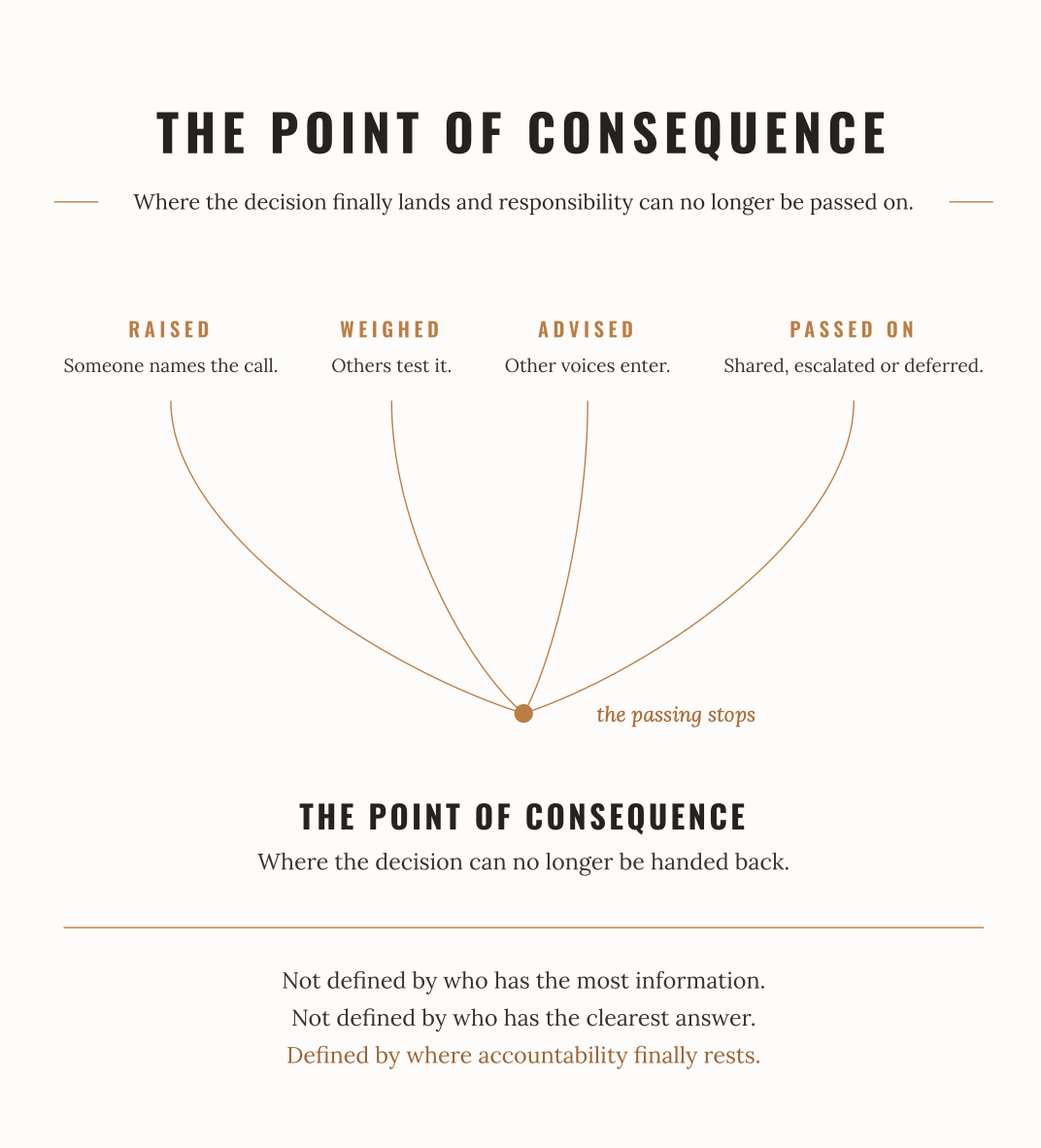
The Point of Consequence
Where does responsibility finally rest? The Point of Consequence is where a consequential decision can no longer simply be passed on and accountability comes to rest with an identifiable person. It makes visible who must ultimately carry the call when the answer is uncertain and the consequences are still unfolding.
The Decision Stability Loop
How does the decision move?
The Decision Stability Loop is the five-step operating sequence:
See · Read · Decide · Act · Stabilise
It follows a decision from recognition into action and through the period that follows, keeping the decision itself, its execution and what happens around it from being treated as the same problem.
The Decision Condition
What surrounds the decision?
The Decision Condition is the state surrounding a consequential decision at a given point. It brings together four dimensions:
Environment · Body · Information · Stakes
Together, they make visible the conditions that may shape how a decision is understood, made and carried.
The Stabilise Action Menu
What can be done when the conditions need work?
The Stabilise Action Menu contains eight practical moves for working on the conditions surrounding an operative decision and its implementation.
The moves are chosen by fit, not followed as a sequence. They work on the conditions around the decision without making or remaking the decision itself.
THE DECISION CONDITION
Read the conditions, not just the decision.
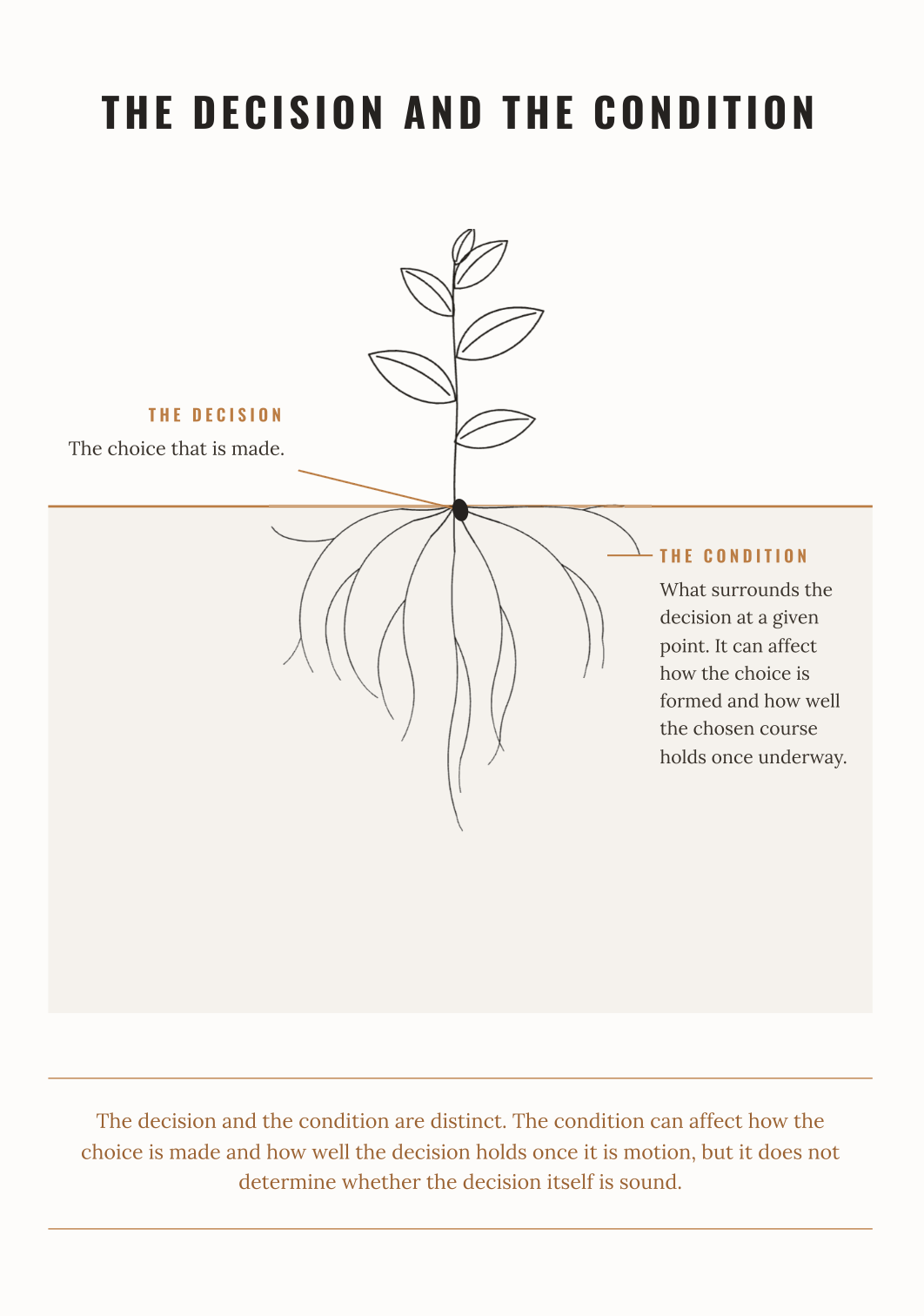
The Decision Condition is the integrated state surrounding a consequential decision at a given point.
It brings together four dimensions:
Environment · Body · Information · Stakes
These dimensions do not determine what the right decision is. They make visible the conditions in which judgement is being formed and the conditions through which a chosen course must operate.
Time pressure, stress, fatigue, uncertainty and emotional load can act across those dimensions. Their effects may be obvious, or they may be mistaken for something else: poor judgement, loss of confidence, a flawed decision or a reason to change course.
Reading the Decision Condition is not about producing a score, diagnosing a person or making the substantive decision. It is about identifying what may be affecting the decision episode before more pressure, effort or deliberation is added.
The decision is one thing. The conditions surrounding it are another. Knowing the difference changes where the work belongs.
THE DECISION STABILITY LOOP
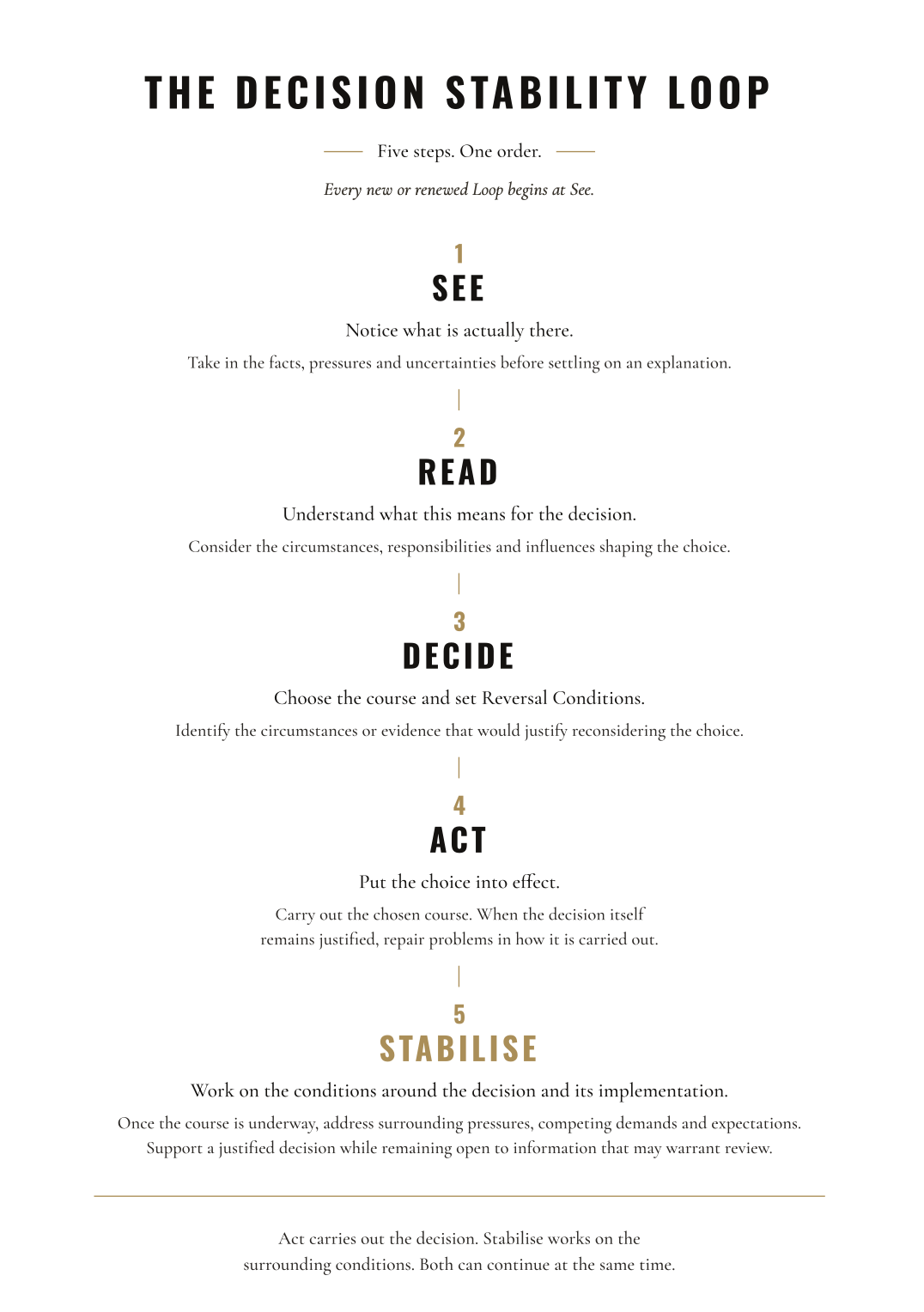
Five steps. One order.
The Decision Stability Loop follows a consequential decision from first recognition, through judgement and action, and into the period after the chosen course becomes operative.
It provides a clear sequence for handling what follows without confusing the decision itself, its execution, the conditions surrounding it or later information.
Notice what is actually there.
Take in the facts, pressures and uncertainties before settling on an explanation. Look beyond your first impression to what you might otherwise miss.
See
Understand what this means for the decision.
Examine what you have noticed and how it affects the choice you face. Consider the circumstances, your responsibilities and the influences that may be shaping your judgement.
Read
Choose the course.
Choose what you will do. Set the Reversal Conditions: the circumstances or evidence that would justify reconsidering that choice later.
Decide
Put the choice into effect.
Take the steps needed to carry out the decision. When the choice remains justified but the way it is being carried out is not working, correct the execution rather than remake the decision.
Act
Work on the conditions around the decision.
Once the chosen course is underway, address surrounding pressures, competing demands and expectations that could undermine it. Support a justified decision while remaining open to information that may warrant reconsideration.
Stabilise
HOLD-OR-FOLD
When the decision is tested.
Not every difficulty means the choice itself needs changing. Before deciding again, distinguish what needs attention: the pressure around the decision, a problem carrying it out, or information that may challenge the reasons behind it.
Hold.
Doubt, resistance or competing demands do not, by themselves, mean the choice was wrong. When the decision remains justified, keep it in force and address the surrounding pressures through Stabilise.
Holding means working on those conditions, not ignoring the difficulty.
The reasons still stand, but continuing has become harder.
Repair.
Correct how the decision is being carried out rather than remake the decision itself. That repair belongs to Act.
Stabilise can continue alongside it, addressing the pressures and expectations surrounding the work.
The choice remains justified, but its execution is failing.
Review.
Information that warrants review is assessed against the Reversal Conditions set at Decide. Does it bear on this decision? Can it be trusted? Is it significant enough to justify reconsideration?
Review tests the information. It does not itself reopen the decision.
Information may challenge the reasons for the choice.
What happens after review?
If review does not establish sufficient grounds for reconsideration, the decision remains in force and Stabilise continues.
When review does establish those grounds, the framework calls this material signal. The decision becomes open to reconsideration, and a renewed Loop begins at See, following the same five steps.
Reconsideration may lead to retaining, modifying or reversing the course. It does not automatically mean changing your mind.
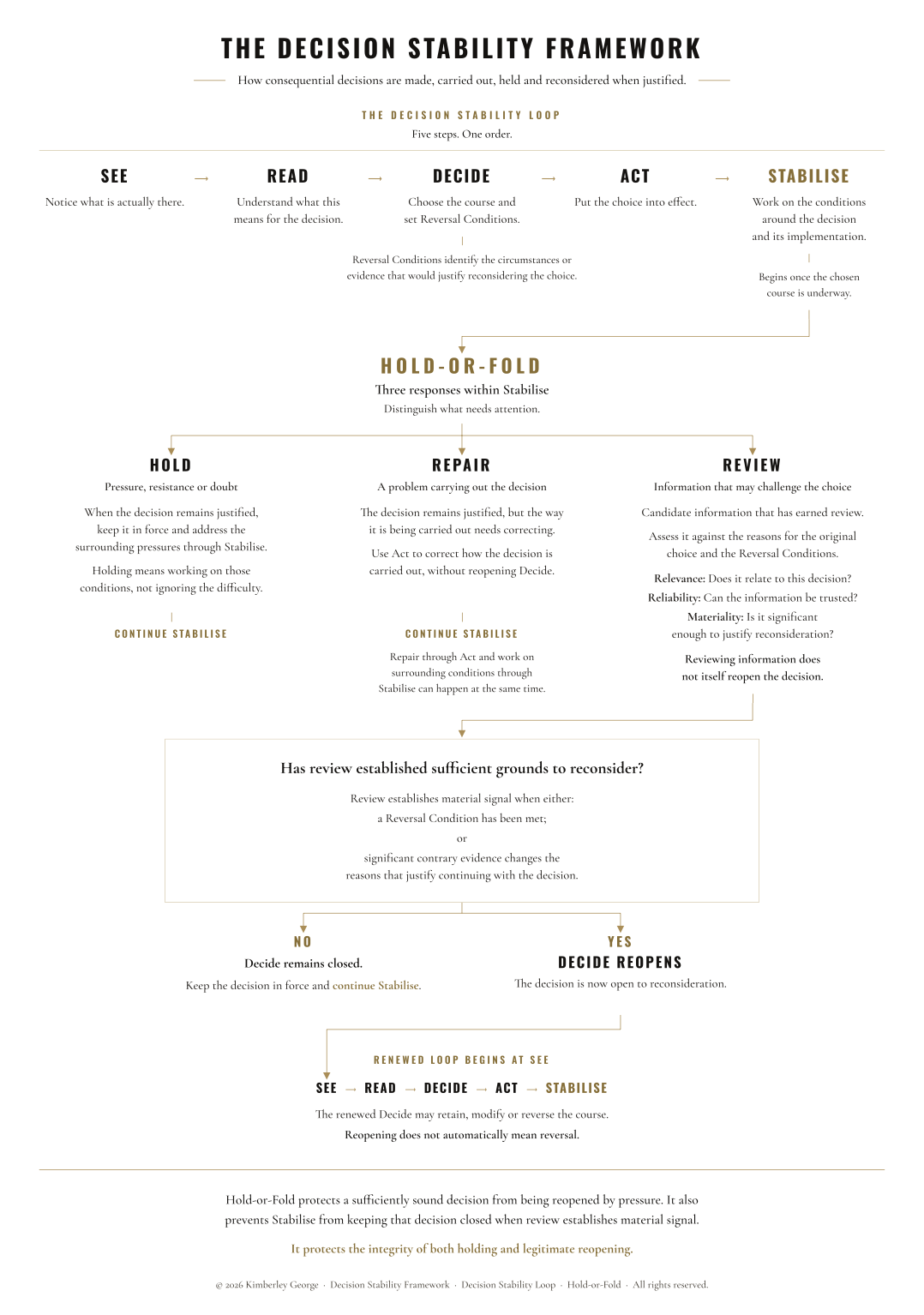
The full framework brings the five-step Loop and Hold-or-Fold together in one operating architecture.
A sufficiently sound decision should not be reopened by pressure alone. New information must meet the conditions for reconsideration before the decision is reopened.
THE DECISION COURSE MATRIX
Persistence alone is not Decision Stability.
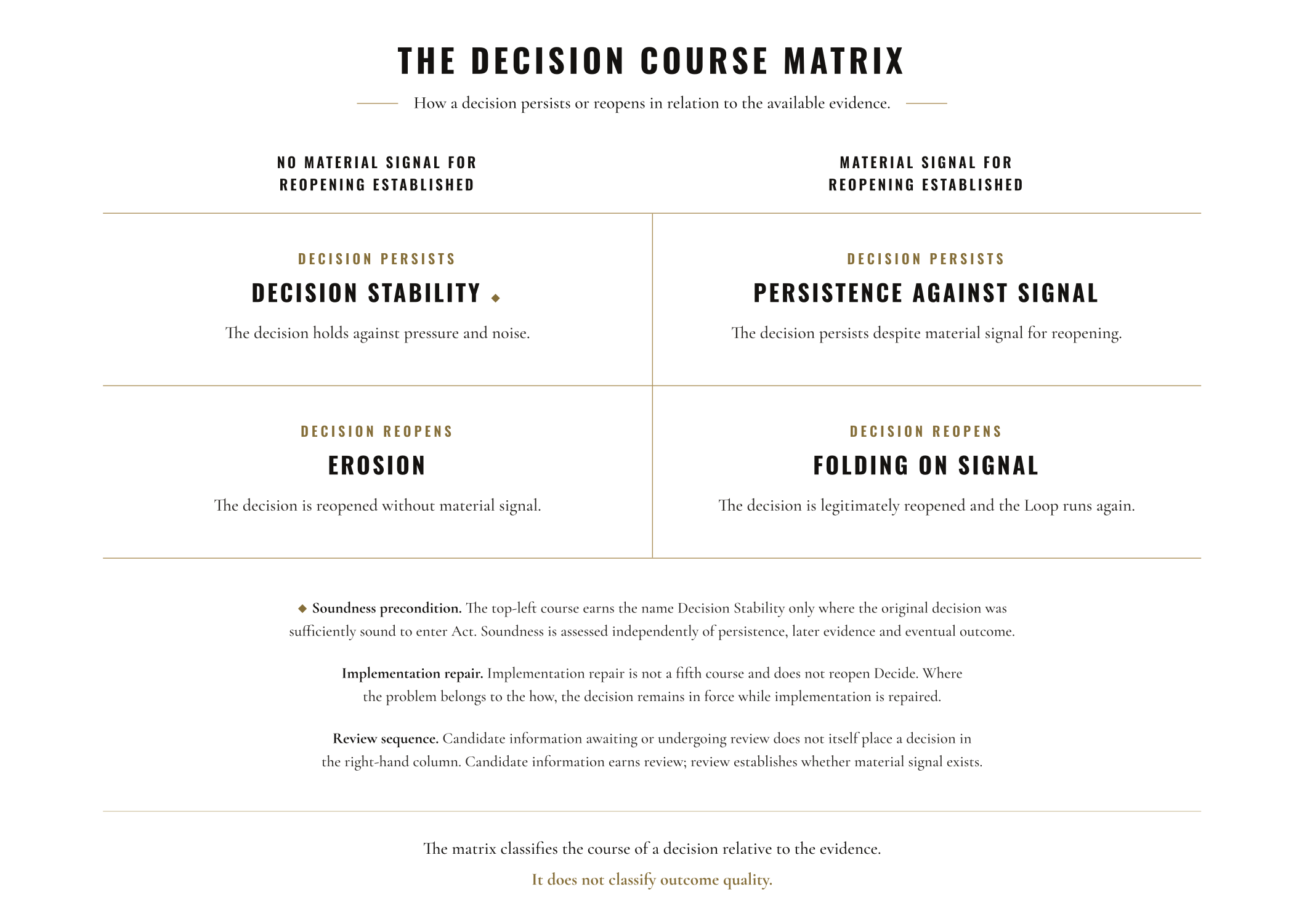
The Decision Course Matrix shows what happens to a decision after it is in motion by separating two questions:
Does the decision persist or reopen?
Has material signal for reopening been established?
That distinction matters because persistence is not automatically Decision Stability, and reopening is not automatically a failure.
How to read the Matrix
Decision Stability describes a sufficiently sound decision that continues to hold while the available evidence supports it.
Persistence against signal occurs when a decision continues despite material signal that supports reopening.
Erosion occurs when a decision is reopened without material signal.
Folding on signal occurs when review establishes material signal and the decision is legitimately reopened.
The Matrix does not judge whether the eventual outcome is good or bad. It classifies the course the decision takes in relation to the available evidence.
Origins and Scope
-
The Decision Stability Framework grew from more than fifteen years spent alongside people carrying consequential decisions across business, government, not-for-profit and private settings.
Across very different decisions, the same problem kept appearing: making the call did not end the work. Once a decision was in motion, pressure, doubt, implementation difficulty, changing conditions and new information could all begin to act on it.
The framework developed from looking at that problem from two directions: the structure of the decision itself and the human conditions surrounding the person responsible for carrying it.
What emerged is the Decision Stability Framework: a way to make that part of the decision lifecycle visible, distinguish what has actually arrived and identify where the work belongs.
-
The framework is designed for consequential decisions that continue to unfold after the choice has been made. These are decisions with meaningful stakes, decisions that may be difficult to reverse and decisions where someone remains accountable while the consequences are still becoming known.
It is not intended for every everyday choice.
Its primary focus is the period after a sufficiently sound decision becomes operative: what should be held through, what needs to be repaired and what has genuinely earned review.
-
The framework does not override urgent safety, legal, regulatory, professional, fiduciary or governance obligations.
Where an immediate obligation requires action to prevent harm or meet a binding duty, that obligation comes first. The decision can then be considered again through the framework.