Decisions That Hold.
Why Some Decisions Survive Pressure and Others Don’t
You made the decision. You acted on it. So why does it keep coming back?
Once a decision is in motion, doubt can return. People push back. Implementation gets messy. Circumstances change. New information arrives. But not every reason to question a decision is a reason to change it.
Decisions That Hold asks a harder question: what pressure should be held through, what needs to be repaired and what has genuinely changed enough to earn review?
It is about protecting a sufficiently sound decision from being abandoned too early, without defending it for too long.
Pressure, execution problems, changing conditions and new information can all challenge a decision. The discipline is knowing whether to hold, repair or review.
Three responses within Stabilise
Once a decision is being carried out, not every difficulty means the choice was wrong. These responses distinguish what needs attention: the pressure around the decision, a problem carrying it out, or information that may challenge the reasons behind it.
Hold. Repair. Review.
Pressure, resistance or doubt
Doubt or resistance does not, by itself, mean the choice was wrong. When the decision remains justified, keep it in force and address the surrounding pressures through Stabilise.
Holding means working on those conditions, not ignoring the difficulty.
Hold
A problem carrying out the decision
The choice can remain justified even when the way it is being carried out is failing. Correct the execution through Act rather than remake the decision itself.
Stabilise can continue alongside that repair, addressing the pressures and expectations surrounding the work.
Repair
Information that may challenge the choice
Assess information that warrants review against the Reversal Conditions set at Decide. Is it relevant, reliable and significant enough to justify reconsideration?
Review tests the information. It does not itself reopen the decision.
Review
Reconsidering does not automatically mean reversing.
If review does not establish sufficient grounds for reconsideration, the decision remains in force and Stabilise continues.
When review does establish those grounds, the framework calls this material signal. The decision becomes open to reconsideration, and a renewed Loop begins at See, following the same five steps. The resulting decision may retain, modify or reverse the course.
THE FRAMEWORK
Five steps. One order.
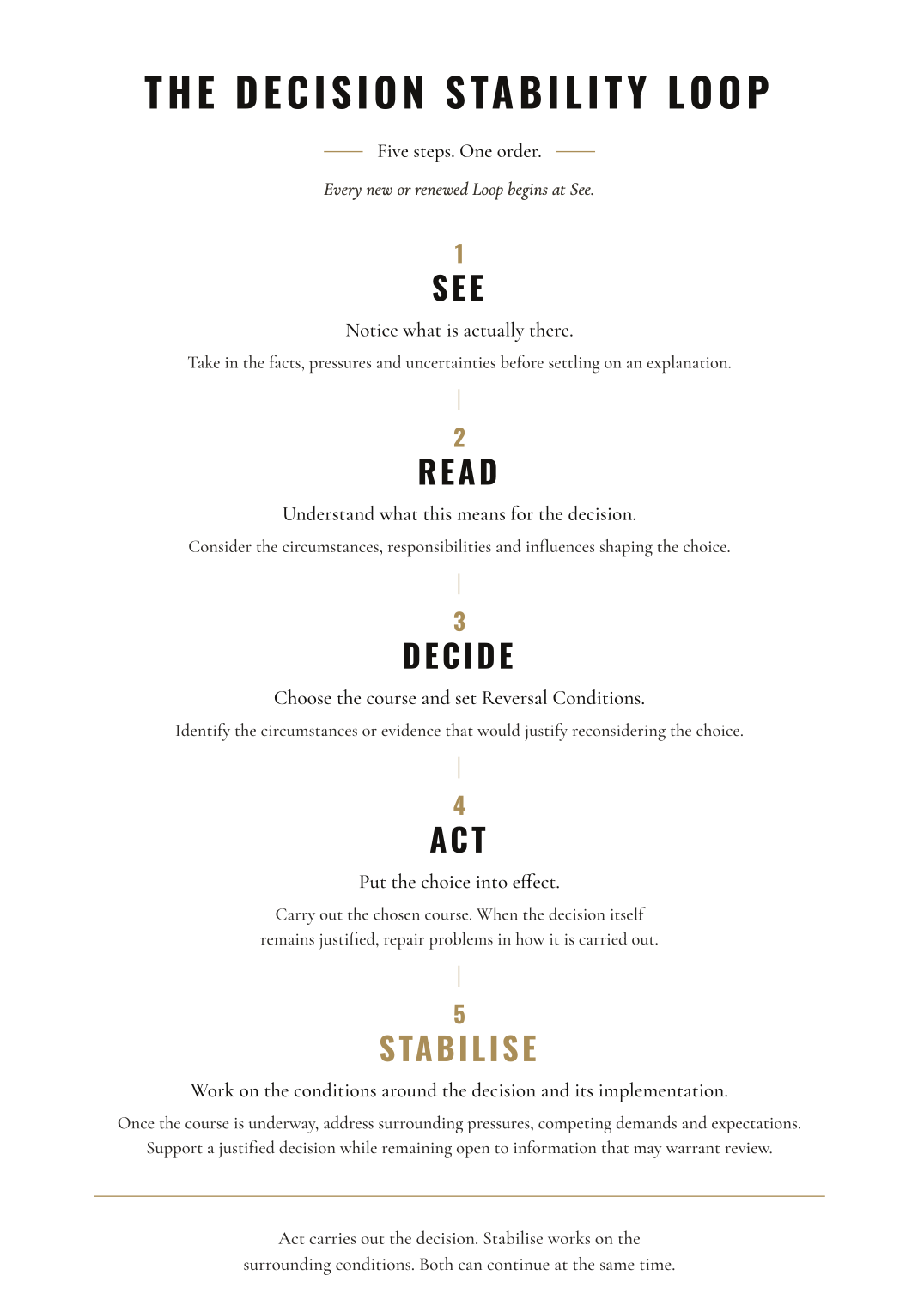
At the centre of Decisions That Hold is the Decision Stability Framework™, a five-step framework for following a consequential decision from what is first recognised and understood, through choice and action, and into what happens next.
Its operating sequence, the Decision Stability Loop™, is:
SEE → READ → DECIDE → ACT → STABILISE
The first four steps carry the decision towards action. Stabilise begins once the chosen course is operative, focusing on the conditions surrounding the decision and its implementation as reality begins to test it.
Within Stabilise, Hold-or-Fold™ distinguishes what has arrived: pressure to hold through, an implementation problem to repair, or information that may genuinely warrant review.
INSIDE THE MANUSCRIPT
The book builds the problem before it reveals the system.
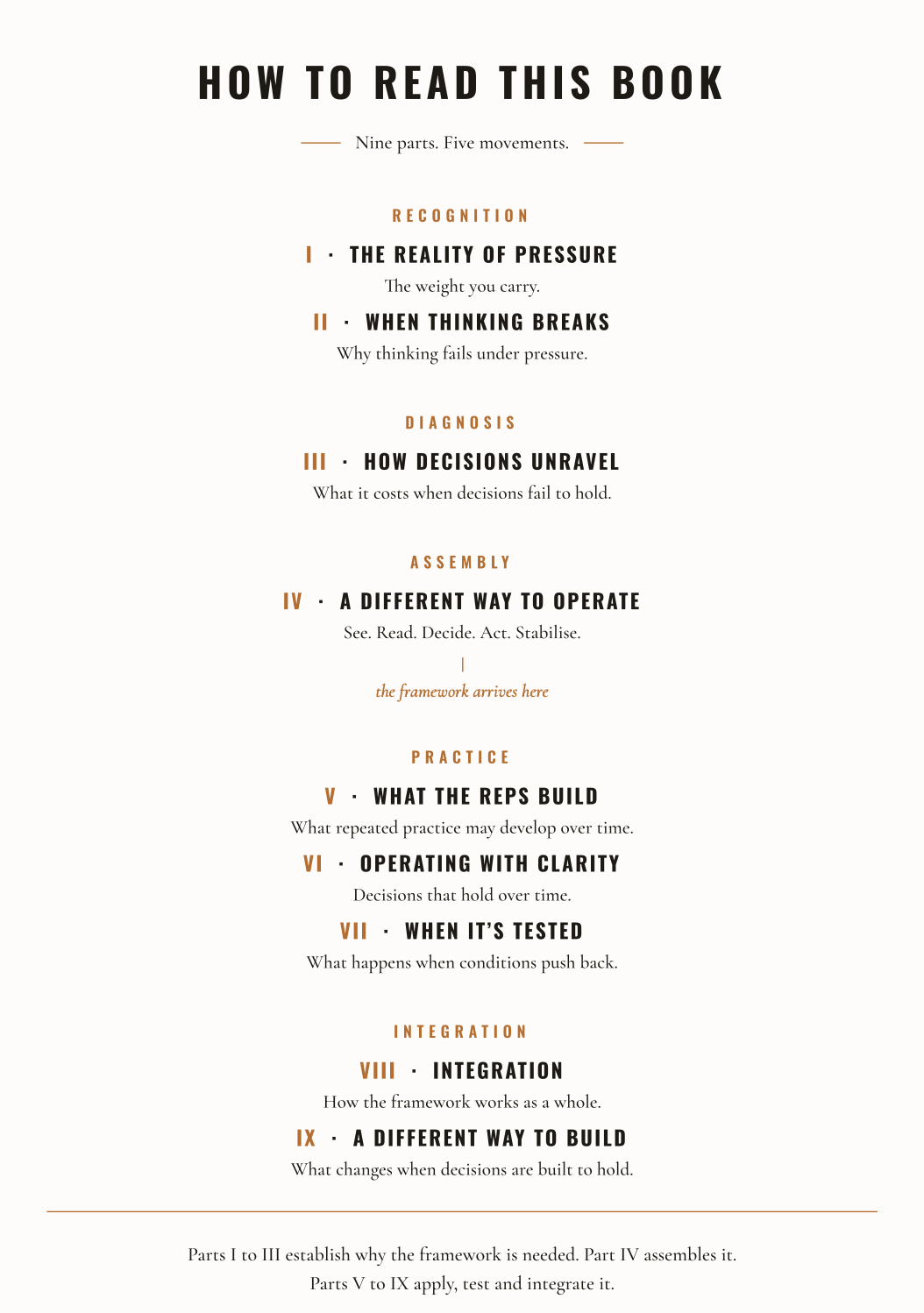
Decisions That Hold unfolds across nine parts and five movements:
Recognition · Diagnosis · Assembly · Practice · Integration
The early parts establish the pressures, responsibilities and recurring patterns that make consequential decisions difficult to carry. The framework then comes fully into view before the book moves into practice, implementation, repeated use, testing and integration.
SOME OF THE IDEAS INSIDE
THE POINT OF CONSEQUENCE: The point at which a consequential decision can no longer simply be handed back and accountability for it finally rests.
THE DECISION CONDITION: The combined state of the environment, the person, available information and the stakes surrounding a decision as it is formed, enacted and carried.
THE STABILITY WINDOW: The period after a chosen course becomes operative and before that course has either become established or legitimately changes.
READERSHIP
For anyone who has had to decide what to do after the decision is made.
Decisions That Hold is written for people navigating important decisions in both life and work, particularly when the answer is no longer as simple as staying the course or changing direction.
The setting may be personal, professional, financial, health-related, family, business or organisational. What connects them is the same problem: something has changed, become difficult or created doubt, and you need to know what that actually means for the decision you made.
For some readers, that will involve leadership, business or professional responsibility. For others, it will be a decision about their own life. The framework is designed to make that underlying problem recognisable across both.
The common ground is not role, title or seniority. It is having made a decision that matters and needing to know what should happen next.
Decisions That Hold is a completed nonfiction manuscript.
PUBLISHING
The manuscript is currently available for literary representation and publishing consideration.
Enquiries are welcome regarding Australian and international publication, territorial and translation rights, audio and other formats, and relevant media opportunities.